


How to Store Luxury Leather Handbags Properly
Table of Contents
- Why Proper Storage Matters for Luxury Leather Handbags
- Prepare Your Handbag Before Storage: Cleaning and Conditioning
- How to Stuff a Handbag for Storage: Maintaining Shape and Structure
- Dust Bags, Breathable Fabric, and Upright Position: The Essentials
- Preventing Leather Bag Color Transfer: Storage and Contact Rules
- Climate Control: Managing Humidity, Sunlight, and Air Circulation
- Best Handbag Storage Organizers: Shelves, Boxes, and Inserts
- Long-Term Storage vs. Daily Rotation: When to Switch Things Up
- Frequently Asked Questions
Last Updated: September 7, 2026
Properly storing luxury leather handbags is the single most important factor in preserving their structure, finish, and long-term beauty, and learning how to store luxury leather handbags properly is the first step every owner should take. Learning how to store luxury leather handbags properly prevents costly damage like creasing, color transfer, and mold growth that can diminish a treasured piece. This guide from Steyn Atelier, a premier destination for authenticated luxury handbags, outlines the precise methods collectors use to protect their investments. Below, we cover everything from pre-storage cleaning to climate control, ensuring your pieces remain as exquisite as the day they were crafted.
Why Proper Storage Matters for Luxury Leather Handbags
Proper storage matters because leather is a natural, porous material that reacts to its environment. Incorrect storage is a leading cause of irreversible damage, including structural sagging, mildew, and faded color. A handbag stored carelessly can lose its shape and luster within a single season, regardless of its original quality.
The goal of preservation is to maintain the bag's structural integrity and leather grain. This involves more than just placing a bag on a shelf; it requires controlling humidity, preventing crease formation, and ensuring the hardware remains untarnished. Consistent, careful storage habits extend the life of a handbag and preserve its appearance for years of enjoyment.
Prepare Your Handbag Before Storage: Cleaning and Conditioning
Before any bag is stored, it must be clean and conditioned to prevent stains from setting. Dirt and body oils attract moisture and can permanently damage the leather over time. A common mistake is storing a bag immediately after use, trapping residues that degrade the material.
Start by gently wiping the entire surface with a soft, dry cloth to remove surface dust. For deeper cleaning, use a dedicated leather cleaner, then apply a conditioner to keep the leather supple and prevent cracking. This step is essential for handbag maintenance. For conditioning, products like Jim's Leather Conditioner nourish the leather, restoring its natural beauty and protecting it against the elements.

How to Stuff a Handbag for Storage: Maintaining Shape and Structure
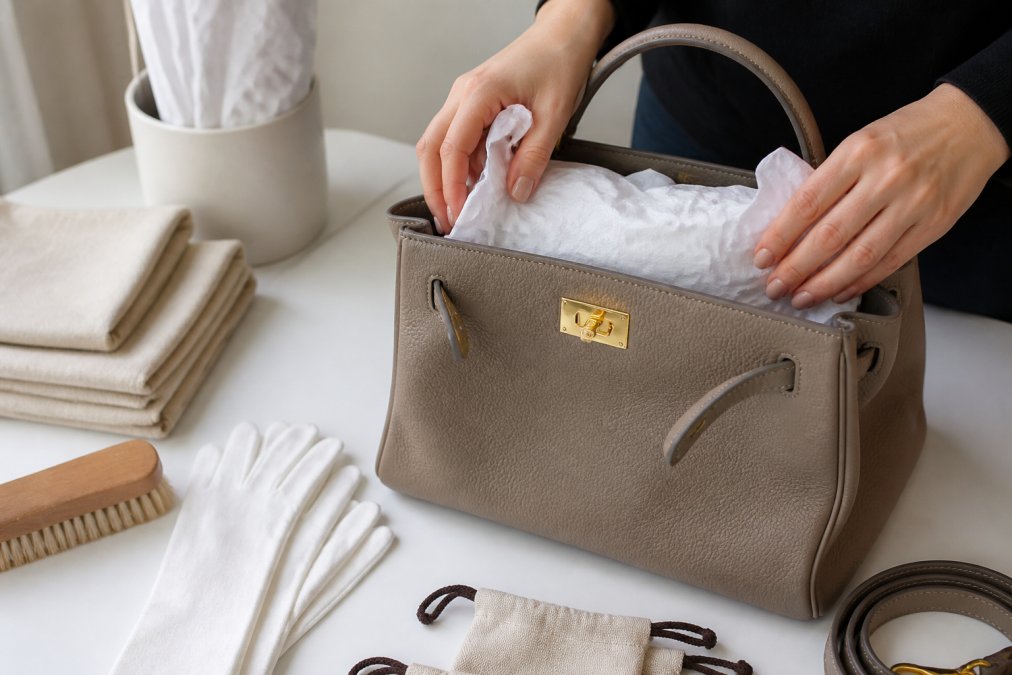
Stuffing a handbag correctly is crucial for shape retention and preventing creases in the leather. The goal is to support the bag's natural silhouette without stretching it. This process helps maintain the bag's structural integrity while it rests.
Use acid-free tissue paper to gently fill the interior. Crumple the paper loosely and fill the bag to its natural shape, paying special attention to the corners and base. Avoid over-stuffing, which can stress the seams. For structured bags with chains or straps, stuff the compartments separately to maintain their form.
Dust Bags, Breathable Fabric, and Upright Position: The Essentials
Storing handbags upright in a non-woven dust bag is the gold standard for preservation. The dust bag protects the leather from light exposure and dust while allowing the material to breathe. Breathable fabric is critical, as it prevents moisture buildup that leads to mildew.
Always store bags in an upright position to prevent the leather from developing permanent creases or sagging. Place the stuffed bag inside its dust bag and set it on a shelf, ensuring it is not crushed by other items. Avoid hanging bags by their straps, as this can distort the leather over time. This method of storage is fundamental for preserving the bag's shape and finish.
Preventing Leather Bag Color Transfer: Storage and Contact Rules
Preventing leather bag color transfer is critical for preserving a bag's pristine appearance. Color transfer occurs when dyes from one material, such as dark denim or another bag, leach onto the leather surface. This is often irreversible and can ruin a light-colored bag.
To prevent this, store each handbag in its own dust bag and never allow bags of different colors to touch. Be mindful of where you place your bag in daily use; setting it on dark fabrics can cause staining. For the best handbag storage organizers, individual compartments or shelves are preferable to allowing bags to nestle together. This separation protects the leather and hardware from scratches and dye migration.
Climate Control: Managing Humidity, Sunlight, and Air Circulation
Leather is hygroscopic, meaning it constantly exchanges moisture with the air around it. The goal of climate control is to keep that exchange slow and steady. The ideal environment is a cool, dark, and stable space with relative humidity (RH) between 40% and 50%. However, the practical steps you take to achieve this will differ dramatically depending on where you live.
High-Humidity Climates (Tropical, Coastal, and Rainy Regions)
In areas where RH regularly exceeds 60%, the primary threat is mold and mildew. Spores are always present in the air; they only need moisture to germinate. For collectors in these regions, a passive approach is not enough.
- Use a Dehumidifier: For a walk-in closet, a small electric dehumidifier is the most effective tool. Aim to keep the RH in the room below 55%. Empty the water reservoir regularly.
- Silica Gel Strategy: Place silica gel packets inside the dust bag, but never directly against the leather. The gel absorbs ambient moisture. A common practice is to use a few large, reusable canisters rather than many tiny packets, as they are easier to monitor. Remember to recharge or replace them according to the manufacturer's instructions, as saturated silica gel is useless.
- Avoid the Floor: Store bags on upper shelves. Ground-level spaces and concrete floors are cooler and harbor more moisture.
- Air Circulation is Key: Do not pack bags tightly together. Leave a few inches of space between each dust bag to allow air to move. Consider leaving the dust bag slightly unzipped to promote airflow, provided the room is not dusty.
Low-Humidity Climates (Arid, Desert, and High-Altitude Regions)
In environments where RH regularly drops below 30%, the primary threat is desiccation. When leather loses moisture too quickly, the natural oils dry out, leading to stiffness, brittleness, and cracking along stress points.
- Introduce Moisture Strategically: A humidifier in the closet during the driest months can help maintain a baseline of 40% RH. This is particularly important in winter when indoor heating exacerbates dryness.
- Condition More Frequently: In dry climates, leather may require conditioning more often than the standard once or twice a year. Monitor the leather's feel; if it feels dry or looks dull, it may need a light application of a high-quality conditioner. However, be careful not to over-condition, which can leave a sticky residue that attracts dust.
- Avoid Direct Heat: Keep bags away from heating vents, radiators, and fireplaces. Forced-air heating is a major culprit in stripping moisture from the air and from leather.
Sunlight and Heat: The Invisible Fade
Regardless of your climate, direct sunlight is a primary enemy. Ultraviolet (UV) rays break down the dye molecules in leather, causing irreversible fading and discoloration. This damage is cumulative; even a few hours of strong sun a week can dull a vibrant color over a season. Heat is equally damaging, as it accelerates the evaporation of natural oils and can cause the leather to warp or become brittle.
- Storage Location: Choose a closet or cabinet that does not receive direct sunlight. If you display bags on open shelving, ensure the room has UV-filtering window film or curtains.
- The 'Cool and Dark' Rule: A general rule of thumb is that if the storage area feels warm to you, it is too warm for your leather goods. A consistent, cool temperature between 60°F and 70°F is ideal.
Monitoring Your Environment
The most reliable way to manage your storage environment is to measure it. A simple, inexpensive hygrometer (a device that measures humidity) can be placed in your closet to give you a real-time reading. This removes guesswork and allows you to adjust your strategy proactively, rather than discovering damage after it has occurred. By tailoring your approach to your specific climate, you move from generic advice to a precise preservation strategy that addresses the most significant environmental threat to your collection.
Best Handbag Storage Organizers: Shelves, Boxes, and Inserts
Choosing the right storage organizers depends on your space and collection size. The best handbag storage organizers protect from dust, light, and physical damage while allowing for visibility and access. Options range from open shelving to archival boxes.
- Open Shelving: Ideal for daily rotation, but bags are exposed to dust and light.
- Clear Acrylic Boxes: Offer visibility and protection from dust, though synthetic materials may not breathe as well as fabric.
- Felt Inserts: These are excellent for inside bags to provide structure and organization. For example, a Felt Insert Bag can help a bag maintain its shape while offering internal pockets for smaller items.
| Storage Type | Key Benefit | Best For |
|---|---|---|
| Non-woven Dust Bag | Breathable protection | Long-term preservation |
| Clear Acrylic Box | Dust-proof visibility | Displaying collection |
| Felt Insert | Internal shape support | Structure and organization |
| Original Box | Maximum protection | Archival storage |
Long-Term Storage vs. Daily Rotation: When to Switch Things Up
Distinguishing between long-term storage and daily rotation is key to a practical preservation strategy. Bags used frequently need accessible storage, while seasonal or special-occasion pieces require more protective measures. This approach ensures that the bags you love are easy to reach, and those you are preserving stay in peak condition.

For daily rotation, keep bags in their dust bags on an open shelf for easy access. For long-term storage, such as over the summer or winter months, use more strong protection like the original box. Regardless of the method, periodically check on stored bags and allow them to air out. This routine prevents stiffness and allows you to catch any potential issues, such as hardware tarnishing, early. The key to leather care is consistency and attention to the environment.
Preserving the beauty of a luxury leather handbag requires deliberate, informed care. From proper stuffing and breathable dust bags to climate control and smart organization, each step protects your piece from the common pitfalls of time and environment. By following these methods, you ensure your handbags remain elegant and structurally sound for decades. For collectors seeking authenticated new and pre-owned luxury pieces, explore the curated collection of Designer Handbags and New Arrivals at Steyn Atelier, where heritage and quality are guaranteed.
Frequently Asked Questions
Should luxury leather bags be stored in their original dust bags?
Yes, storing luxury leather handbags in their original dust bags is the best practice. The non-woven dust bag acts as a breathable fabric that protects against dust and light while allowing air circulation. Avoid plastic storage at all costs, as it traps moisture and can lead to mold and mildew. For long-term preservation, place the dust-bagged handbag upright on a shelf, never hanging by its straps.
How do you prevent mold and moisture damage in leather handbags?
Preventing mold and moisture damage starts with climate control. Store your handbags in a room with relative humidity between 40-50%. Use silica gel packets inside the storage area to absorb excess moisture, but never let them touch the leather directly. Ensure proper ventilation and air circulation around your bags, and avoid storing them in basements or attics where humidity fluctuates dramatically.
Is it better to hang or shelf store designer handbags?
Shelf storage is almost always better than hanging for luxury leather handbags. Hanging puts stress on the straps and can cause structural damage or crease prevention issues over time. Store handbags upright on a shelf in their dust bags with internal stuffing to maintain shape. If you must hang a bag, use a padded hanger and only for short periods between uses.
How often should you condition leather handbags in storage?
For handbags in long-term storage, conditioning every 6 to 12 months is recommended. Use a product like Jim's Leather Conditioner, which nourishes the leather grain and prevents cracks. Always clean the bag before applying conditioner, and allow it to absorb fully before returning the bag to its dust bag. Over-conditioning can saturate the leather, so follow the product instructions carefully.