


How to Spot Fake Designer Leather: A 2026 Guide
Table of Contents
- Why Spotting Fake Designer Leather Is Harder Than Ever
- Signs of Authentic Leather Every Buyer Should Know
- How to Tell Real Leather from Fake: A Step-by-Step Inspection
- Common Flaws in Counterfeit Leather Goods
- The Superfake Phenomenon and Micro-Authentication of Hardware
- Digital Authentication Tools and Legal Implications
- Conclusion
Last Updated: August 8, 2026
Why Spotting Fake Designer Leather Is Harder Than Ever
The counterfeit luxury goods market has grown sophisticated enough to fool even seasoned collectors. Modern counterfeits replicate textures, hardware finishes, and interior stampings with alarming precision. According to the U.S. Customs and Border Protection report on intellectual property rights seizures, counterfeit goods seizures consistently rank luxury handbags and accessories among the highest-value categories intercepted at the border.
The most dangerous fakes, often called "superfakes", pass every surface-level test. This guide covers every layer of the authentication process: from how genuine leather smells and feels, to the precise tolerances of authentic hardware, to the digital tools now available to buyers.
Signs of Authentic Leather Every Buyer Should Know
Authentic leather carries physical characteristics that synthetic and faux leather materials simply cannot fully reproduce. These signs are rooted in the biology of animal hide and the tanning process that transforms it into a luxury material.
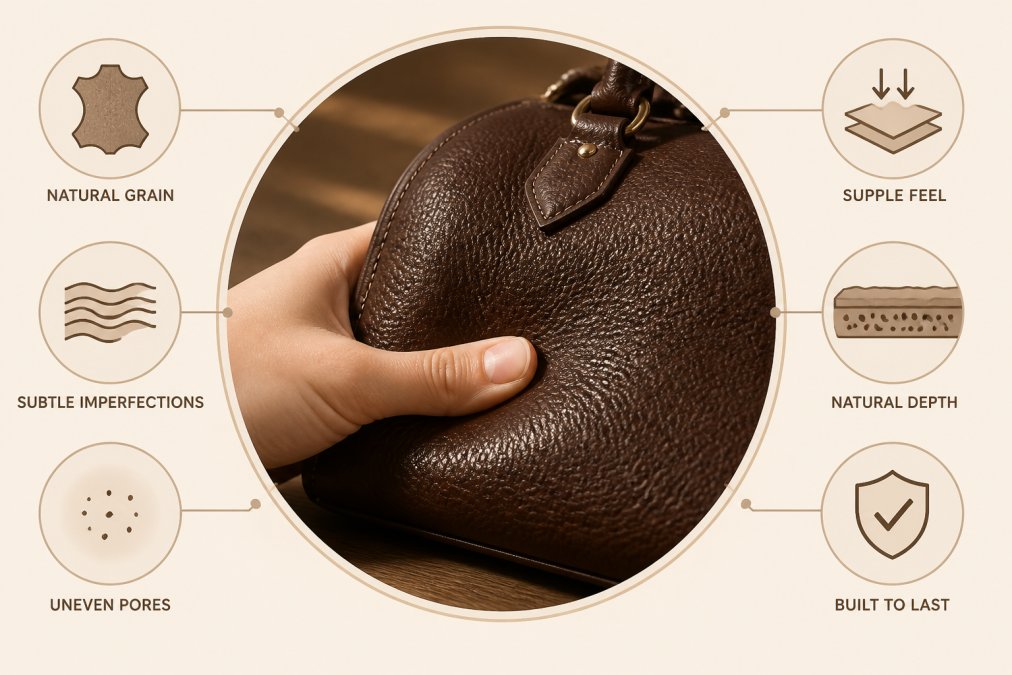
Genuine leather has a natural grain that is irregular and unique, no two panels look identical. Synthetic materials display a repeating, almost mechanical pattern. Run a finger across the grain: real hide has microscopic variation, tiny pores, and subtle ridges that reflect light differently depending on angle. Faux leather feels uniform, slightly plasticky, and cool to the touch.
Patina is another reliable indicator. Over time, genuine leather develops a rich patina, a subtle darkening and softening at stress points like handles and corners. This natural aging process cannot be chemically replicated convincingly. A bag with heavy use but no patina development is a red flag.
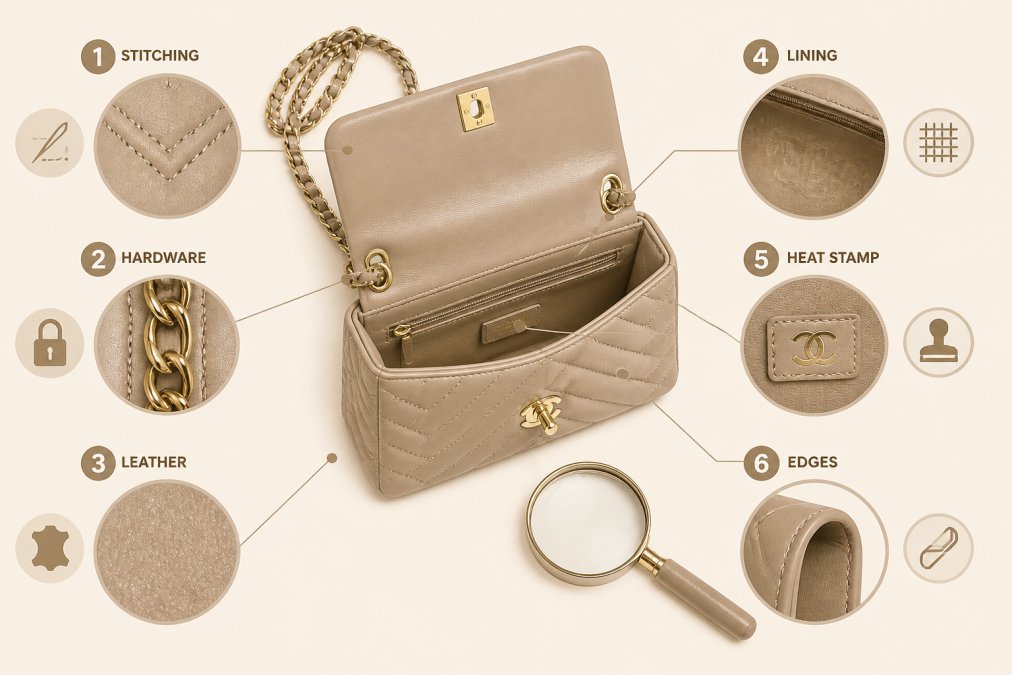
Edge painting also tells a story. On authentic luxury goods, cut edges of leather panels are carefully finished with multiple layers of edge paint or burnishing, creating a smooth, rounded profile. Counterfeits frequently show rough, peeling, or uneven edge treatment.
The Smell Test: Genuine Leather vs. Synthetic
Genuine leather has a distinctive, organic smell resulting from the tanning process, a rich, slightly earthy scent with warm undertones. This smell is difficult to fake convincingly and tends to deepen rather than fade with age.
Synthetic and faux leather materials typically smell of plastic, chemical solvents, or artificial fragrance. Some counterfeit manufacturers spray genuine leather scent onto fake goods, but the effect dissipates quickly and often smells sharp or one-dimensional.
Press the bag closed briefly, then open it and smell the interior. Authentic luxury goods carry that warm, complex leather note. A chemical or plastic smell from the interior is a strong indicator of fake designer leather.
Texture, Patina, and the Buttery Feel of Real Hide
High-quality genuine leather has what collectors describe as a "buttery texture", a softness that yields slightly under pressure without feeling spongy. This quality comes from the tanning process and the grade of hide used. Full-grain leather, the highest quality, retains the outermost layer of the hide with all its natural characteristics intact.
Press firmly into the leather surface with a thumb. Genuine leather will show a slight wrinkle or crease that smooths out gradually when pressure is released. Synthetic materials tend to either resist the impression entirely or crease sharply without recovering naturally.
How to Tell Real Leather from Fake: A Step-by-Step Inspection
Knowing how to tell real leather from fake requires a systematic approach. The following process moves from the outside in, covering the elements most likely to reveal a counterfeit.
Step 1: Examine the Stitching Quality and Precision
Stitching quality is one of the most reliable authentication markers on any luxury leather good. Authentic pieces are assembled with tight, even stitches at consistent intervals, typically hand-stitched or sewn on precision industrial machines calibrated to specific stitch counts per centimeter.
Look for consistent stitch spacing with no variation across the entire seam, thread color that matches exactly across all panels, no loose threads or skipped stitches, reinforced stress points at handles and strap attachments, and saddle stitching on high-end pieces, two needles working from opposite sides, creating a distinctive X pattern when viewed closely.
Counterfeit stitching frequently shows uneven tension, slight wavering along seam lines, and thread ends that are cut rather than properly finished.
Step 2: Inspect Hardware, Plating, and Zipper Finish
Hardware micro-authentication is where many buyers stop short. Authentic luxury hardware is cast from solid brass or zinc alloy and then plated to precise specifications. Hold the hardware and assess its weight, genuine hardware feels substantial. Counterfeit hardware is often hollow or made from lightweight alloys that feel noticeably lighter.
Examine the plating under good light: authentic gold or silver plating is uniform, without thin patches, bubbling, or discoloration at edges. A common flaw in counterfeit leather goods is hardware that shows brass bleeding through the plating at corners or attachment points.
Zipper quality is equally telling. Authentic luxury zippers, often from manufacturers like Lampo or Riri, operate with smooth, consistent resistance and feature precisely stamped branding on the pull. Counterfeits frequently use generic zippers that catch, feel gritty, or display blurred, shallow stamping.
Examine logo embossing on hardware closely. On authentic pieces, embossed lettering is crisp, with uniform depth and clean edges. Counterfeit embossing tends to show rounded, shallow characters with inconsistent depth.
Step 3: Check Serial Numbers, Date Codes, and Font Alignment
Serial number and date code verification requires attention to font alignment, character spacing, and placement consistency. Authentic luxury houses use specific fonts, character sizes, and placement conventions that remain consistent across production runs.
Photograph the serial number or date code and examine it at high magnification. Authentic stampings show uniform character height and spacing with no variation, clean sharp edges on each character, consistent depth across the entire stamped area, and correct font matching the house's documented specifications for that period.
Font alignment is a surprisingly reliable tell. Counterfeits frequently show slight rotation of individual characters, inconsistent kerning, or the wrong typeface altogether. Cross-reference the date code format against documented examples for the specific brand and production year.
The interior stamp should also match the exterior hardware finish in terms of quality. A bag with flawless exterior hardware but blurry interior stampings is almost certainly counterfeit.
Step 4: Verify the Lining, Dust Bag, and Packaging
The lining of an authentic luxury piece reflects the same quality standards as the exterior. Genuine linings are cut precisely, sewn flat without puckering, and finished with the same attention to detail as the outer panels. Common flaws in counterfeit leather goods include lining fabric that is slightly off-color, loosely attached at the base, or printed with a pattern that doesn't align at seams.
Dust bag authenticity is frequently overlooked. Authentic dust bags are made from soft, high-quality fabric with consistent stitching, correctly sized for the specific piece, and marked with branding that matches the house's current specifications exactly. Counterfeit dust bags often use thinner fabric, show off-register printing, or include misspellings and font inconsistencies.
| Inspection Area | Authentic Indicator | Common Counterfeit Flaw |
|---|---|---|
| Stitching | Even, tight, consistent spacing | Uneven tension, skipped stitches |
| Hardware | Solid weight, crisp embossing | Lightweight, blurred stamping |
| Serial number | Sharp font, consistent depth | Blurry characters, wrong typeface |
| Lining | Flat, precise cut, no puckering | Off-color, loose at base |
| Dust bag | Quality fabric, correct branding | Thin material, misspellings |
| Leather smell | Organic, earthy, warm | Chemical, plastic, or artificial |
Common Flaws in Counterfeit Leather Goods
The most common flaws in counterfeit leather goods cluster around the details that require the most manufacturing investment. Logo placement is a consistent failure point. Authentic houses follow precise specifications for logo size, position, and orientation relative to seams and hardware. Counterfeit logos are frequently positioned slightly off-center, sized incorrectly, or printed with ink that shows through the material when held to light.
Manufacturing defects on counterfeits often appear at the interior base corners, where lining meets the leather shell. Authentic pieces show clean, reinforced corner construction. Counterfeits frequently show excess adhesive, unfinished edges, or lining that has already begun to separate.
The tanning process used on genuine leather produces a material that responds predictably to moisture, heat, and use. Synthetic materials behave differently and may show surface cracking within months of purchase, while genuine leather with proper care develops character over years.
The Superfake Phenomenon and Micro-Authentication of Hardware
The "superfake" phenomenon represents a genuine escalation in counterfeit quality. Superfakes are high-investment replicas produced with better materials, more precise manufacturing, and closer attention to the details that casual buyers check first. According to the Authentics Foundation's overview of luxury counterfeiting trends, the production quality of high-end counterfeits has increased substantially over the past decade.
Micro-authentication of hardware is the most effective counter to superfakes. Examine hardware at magnification, a jeweler's loupe at 10x is sufficient for most purposes. At this magnification, authentic hardware reveals consistent plating thickness with no thin spots at edges, machined precision on screw heads and clasps, uniform engraving depth across logo or text elements, and no casting seams on visible faces.
Superfakes consistently fail micro-authentication because the tooling required to replicate hardware at this precision is prohibitively expensive.
Digital Authentication Tools and Legal Implications
Digital authentication tools have changed the verification landscape significantly. Several independent authentication services now offer app-based and mail-in authentication for luxury goods, using high-resolution imaging, database comparison, and specialist review.
As documented in the U.S. Federal Trade Commission's guidance on counterfeit goods, purchasing or selling counterfeit luxury goods carries real legal exposure. Knowingly selling fake designer leather goods as authentic constitutes fraud under federal law.
From a practical standpoint, buyers should request authentication documentation for any significant purchase. Reputable pre-owned luxury platforms authenticate pieces before listing them, and that documentation should accompany the item. If a seller cannot provide authentication records or declines to submit a piece for independent verification, that reluctance is itself a meaningful signal.
The second-hand market for authentic luxury leather goods continues to attract serious collectors and fashion enthusiasts. Historical market behavior shows that well-maintained, authenticated pieces in desirable styles tend to hold interest among collectors, though value varies by model, condition, color, age, and market demand, and no specific outcome can be predicted for any individual item.
For buyers who want confidence without the burden of conducting a full inspection themselves, platforms that guarantee authenticity on every piece remove the risk from the equation. Steyn Atelier's curated collection carries a 100% authenticity guarantee on every purchase, with expertise shaped by years of direct experience with genuine luxury goods. The collection spans designer handbags, wallets, and accessories, all verified before reaching the buyer.
For buyers who already own genuine leather pieces, proper care preserves both the condition and the long-term integrity of the material. Jim's Leather Conditioner with Applicator, available through Steyn Atelier, nourishes and protects genuine leather, preventing the cracking and dryness that accelerates deterioration. For patent leather pieces, Jim's Patent Leather Foam Cleaner Kit maintains the distinctive finish that makes these items so recognizable.

The International Anti-Counterfeiting Coalition's resources on protecting consumers provides additional guidance for buyers who want to understand their rights and options when they suspect they have received a counterfeit item.
Authenticating luxury leather goods requires more than a quick look at the logo. The combination of material knowledge, systematic inspection, and access to the right tools is what separates confident buyers from those who rely on luck. Steyn Atelier's team brings deep leather craftsmanship expertise to every piece in its collection, with 100% authenticity guaranteed on every purchase across designer handbags, accessories, and apparel. For collectors and enthusiasts who want that certainty built in from the start, exploring Steyn Atelier's curated new arrivals is the straightforward next step.
Frequently Asked Questions
How can I tell if a handbag is real leather without damaging it?
Press your fingertip firmly into the surface for a few seconds. Genuine leather warms slightly and shows a faint impression that fades, while synthetic materials stay cool and spring back immediately. The smell is another reliable indicator: real leather carries an earthy, organic scent from the tanning process, whereas faux leather typically smells of plastic or chemicals. Examining grain irregularity under good light also helps, since authentic hides show natural variation rather than a repeated stamped pattern.
What are the most common signs of fake designer leather goods?
Counterfeit leather goods most often fail on stitching, hardware, and material composition. Look for uneven stitch spacing, thread color mismatches, and loose ends. Hardware on fakes tends to feel lightweight, shows plating wear quickly, and may carry misspelled or misaligned engravings. The leather itself is frequently synthetic, with a uniform, almost plastic-like surface that lacks the natural patina and edge painting detail found on authentic luxury goods. Manufacturing and care instruction labels also frequently contain font inconsistencies or spelling errors.
What is a 'superfake' and how is it different from a regular counterfeit?
A superfake is a high-grade counterfeit produced with significantly better materials and manufacturing than standard fakes, often mimicking the weight, stitching precision, and hardware finish of authentic luxury goods closely enough to fool casual inspection. Unlike typical counterfeits, superfakes can replicate serial numbers and date codes with near-accuracy. Spotting them requires micro-level hardware inspection, UV light checks on lining stamps, and cross-referencing serial numbers against official brand records. Professional authentication services and digital tools are the most reliable recourse when superfakes are suspected.
Is buying a counterfeit designer bag illegal in the United States?
Purchasing a counterfeit luxury good for personal use occupies a legal gray area in the United States, but knowingly buying, importing, or reselling counterfeit goods can expose buyers to civil liability and, in commercial quantities, federal criminal charges under the Lanham Act and the Stop Counterfeiting in Manufactured Goods Act. U.S. Customs and Border Protection routinely seizes counterfeit shipments. Beyond legal risk, purchasing fakes undermines the craftsmanship and heritage that define luxury goods and can expose buyers to financial loss when attempting resale on the second-hand market.